|
 |
The Old St Beghian | |
| July 2026 | |||
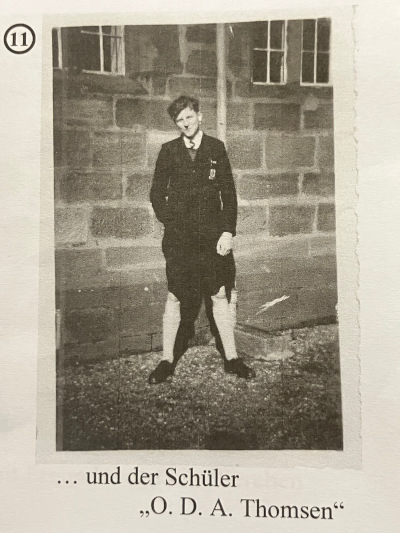
Olaf Thomsen (F 49) died peacefully on 14th November 2025, aged 94.
His daughter, Gabriele, kindly provided the following details.
“Olaf worked for the Pharmaceutical Division of the German company Bayer AG and from 1959 to 1963 was managing director of Bayer de Colombia Ltd. of Bogota, Colombia. From 1961 onwards he had been a member of the Lions Club International.
In August 1991 he visited the school and village to where he had first come as a German exchange student for two terms, and retained vivid memories of his time and the friends he made, remembering especially J. G. Bullivant (FS 45-49), T. C. Seymour (F 44-50), R. Allison (F 44-49) and W. G. W. Morrison. In later life he wrote a book about his family history, and Gabriele has sent some extracts relating to his time at St Bees, from which the following are taken.”
‘It was at the end of 1948 when I and a few other classmates received an invitation from the British military government in Germany to visit an English school. The aim of this programme, which ran throughout the British occupation zone, was presumably to rid German youth of the virus of militarism and National socialism in an age group where service in the Hitler youth and engagement in paramilitary exercises was virtually compulsory. In January 1949, they sent me and several others to England.
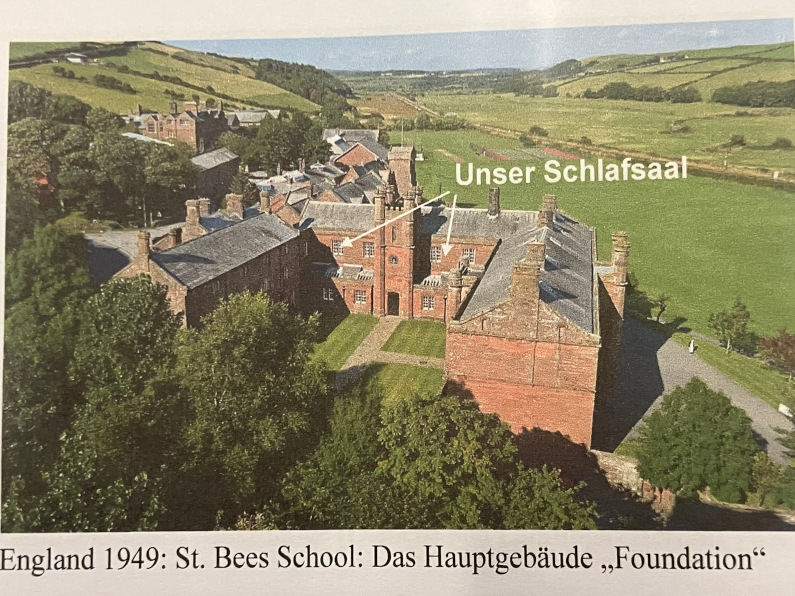
In London we were accommodated in a YMCA hostel near Hyde Park and there I was informed that the next morning I would be travelling to St Bees, opposite the Irish coast, and that I was the only one headed there. The village of St Bees had about 1500 inhabitants at the time. Before I could begin my life as a student I had to endure a few things. First, I was completely outfitted and given the usual school uniform. Then I had to get a Certificate of Registration, which I had to take to the local police station at St Bees every month. I soon came to know the village policeman, Constable Atkinson, as a kind friend and helper.
The first thing I had to get used to at school were the strict rules and regulations. Punctuality and discipline were paramount. Students were only allowed to use certain entrances. Smoking and any contact with girls were strictly forbidden. Violations of rules were sometimes punished with beatings. I personally witnessed a student being beaten with nine strokes of a stick, almost to the point of needing hospitalisation, all because he had gone for a walk with a girl on the nearby golf course. Incidentally, these punishments were usually not handled by the teachers but by the oldest students, the prefects. Sport was an important part of the curriculum, and the boarding school also served as a cadet academy, with once a week a rigorous drill under the direction of a former army captain.
In retrospect I wouldn’t want to miss the experiences I had at the school, but at that time I didn’t find them particularly enriching: the aversion to ‘the evil Germans’ was still palpable among some students – often painfully so! In 1949 I left St Bees to go back to Germany.’
1949 Whole School Photograph
Olaf is standing in the back row, 15th from the righthand end
Link to the 1949 photograph on the Society website is here.

Home
The St Beghian Society
St Bees School,
St Bees, Cumbria, CA27 0DS.
Tel: (01946) 828093 Email: osb@stbeesschool.co.uk
Web: www.st-beghian-society.co.uk
